

Table of Contents
- Why Buying Stylish Bags for Your Daily Commute Changes Everything
- What to Look for When Buying Stylish Bags for the Subway and Street
- The Best Work Bags for Commuting Balance Form and Function
- Why a Work Bag with Shoe Compartment Beats Carrying Two Bags
- Comfortable Bags for Walking to Work: Straps, Weight, and Load
- The Longevity of Luxury Commuter Bags
- Conclusion: One Bag That Carries Your Whole Day
Last Updated: October 9, 2026
Why Buying Stylish Bags for Your Daily Commute Changes Everything
Most commuters solve the same problem twice a day: one bag for work, another for the gym. When you buy stylish bags for your daily commute, you stop negotiating with yourself at the door.

The two-bag problem is a design failure, not a discipline problem. You are not disorganized. You are carrying equipment that was never engineered to travel together.
The Two-Bag Problem
A work bag protects a laptop and looks composed in a meeting. A gym bag ventilates shoes and survives the floor.
What to Look for When Buying Stylish Bags for the Subway and Street
Buy stylish bags for daily commute use by prioritizing four things: a structured silhouette, a separate laptop compartment, load-bearing straps, and quality materials. Everything else is decoration.
The subway tests a bag in ways a showroom never will. Doors close on it, strangers lean into it, and the floor is a biohazard.
- Structured profile: holds its shape whether empty or packed
- Dedicated laptop sleeve: suspends the device off the bag's base
- Ventilated shoe compartment: keeps odor away from clothing
Structured Profile vs. Flexible Maneuverability
A bag that is rigid everywhere is a bag you fight on a crowded train. Look for structure in the panels and flexibility at the seams.
The Manhattan, our two-tier commuter tote, is structured in key areas to hold a crisp geometric profile while staying flexible enough to maneuver a crowded subway. That balance is the whole design brief.
The Best Work Bags for Commuting Balance Form and Function
The best work bags for commuting are the ones that pass as office-appropriate while hiding everything you need for the gym.
Most "hybrid" bags fail on one side of that equation. They look athletic in a client meeting, or they look so formal that a pair of sneakers ruins the silhouette.
A bag that works for both reads as a single considered object. No bulging side pocket. No visible mesh. No logo shouting about fitness.
Feature |
Why It Matters |
What to Avoid |
|---|---|---|
Structured silhouette |
Holds shape in meetings and on transit |
Collapsing soft-sided totes |
Dedicated shoe compartment |
Separates gear from clothing |
Shared main cavity |
Laptop sleeve |
Protects tech from impact |
Sleeves resting on the base |
Wipeable lining |
Handles spills and odor |
Unsealed fabric interiors |
Load-bearing straps |
Reduces shoulder fatigue |
Thin, unpadded webbing |
Why a Work Bag with Shoe Compartment Beats Carrying Two Bags
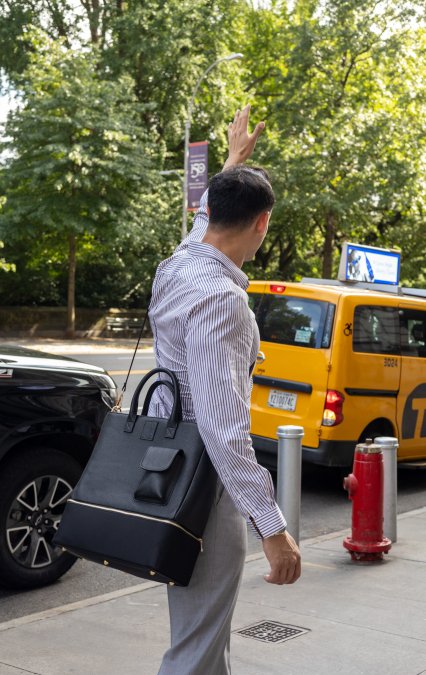
A work bag with shoe compartment eliminates the second bag entirely. One bag means one hand free, one shoulder loaded, and one object to keep track of on a moving train.
Two bags also double your failure points. Two straps to adjust, two zippers to check, two things to set down and forget.
The Manhattan's bottom compartment uses ventilation grommets and a wipeable nylon lining to combat odor from shoes or spills.
Security on a Crowded Platform
Protection is not only about impact. On a packed train, an open compartment is an invitation. Look for zippers that sit against the body when the bag is carried crossbody, a hidden interior pocket for a phone or transit card, and a main opening that cannot be reached from behind. A laptop sleeve tucked against your back, rather than on the outward-facing panel, is materially harder to access in a crowd.
The Manhattan Two-Tiered Commuter Bag →
Comfortable Bags for Walking to Work: Straps, Weight, and Load
Comfortable bags for walking to work distribute weight across the body rather than hanging it from one point. Strap design and bag geometry matter more than total weight.
Shoulder fatigue builds from two sources: narrow straps that concentrate pressure, and a bag whose center of gravity sits away from your body.
- Carry by the handles for short walks and crowded platforms
- One shoulder for quick transitions
- Crossbody with the adjustable strap for longer walks and heavier loads
Crossbody carry pulls the bag against your torso, which shifts load off the shoulder and onto the trunk.
The Longevity of Luxury Commuter Bags
Weather: What Water-Resistant Actually Means
"Water-resistant" and "waterproof" are not the same claim, and most commuter bags are the former. Water-resistant leather and coated nylon shed a light rain or a splash from a passing cab. They will not survive a sustained downpour with an unprotected laptop inside.
A practical routine for wet commutes:
- Before you leave: check the forecast. If rain is likely, move electronics into the interior sleeve and close every zipper fully, a partially open zipper is a funnel.
- During the commute: carry the bag with the leather panel facing your body and the nylon base facing out. The base is the sacrificial surface.
- After you arrive: blot the leather with a dry cloth and let the bag air-dry away from radiators and direct sun. Heat dries leather unevenly and causes cracking.
A Maintenance Schedule That Extends the Bag's Life
Most guides stop at the purchase. The owners who get longevity out of a bag follow a simple rhythm:
- Weekly: empty the bag completely, wipe the lining, and let the shoe compartment air out overnight.
- Monthly: wipe the leather with a dry cloth and check the stitching at the handle attachments and strap anchors for fraying. Catch a loose thread early and a repair shop can reinforce it; catch it late and the anchor fails under load.
- Seasonally: condition full-grain leather with a quality leather cream. Condition sparingly, over-conditioning softens the structure that gives the bag its Art Deco profile.
- Annually: inspect the hardware for corrosion or looseness and have a cobbler or leather specialist tighten or replace anything that has worked free.
Repair Before You Replace
Stitching, hardware, and strap anchors are all repairable. A split seam at a handle attachment is a routine fix for a leather specialist and costs far less than a new bag. Zipper replacement is more involved but still common. The parts of a well-built bag that fail first are almost always the parts that can be fixed.
A bag treated like equipment lasts like equipment.
Conclusion: One Bag That Carries Your Whole Day
The real cost of the two-bag habit is not the second bag. It is the daily friction of deciding, juggling, and arriving at the office looking like you moved house.
The Manhattan is our answer: a two-tier commuter tote in premium Italian Togo leather, with a ventilated shoe compartment, a purpose-built laptop section, and a structured Art Deco silhouette that holds up in a client meeting and on the platform.
Get started with Mesta - New York and carry your whole day in one bag.